Princeton University is one of the most prestigious and influential institutions of higher education in the world. Located in Princeton, New Jersey, United States, the university is renowned for its academic rigor, distinguished faculty, and strong commitment to undergraduate education. As a member of the Ivy League, Princeton has shaped generations of leaders, scholars, scientists, and innovators who have made lasting contributions to society. With a rich history, a beautiful campus, and a global reputation for excellence, Princeton University continues to stand at the forefront of education and research.
History and Foundation
Princeton University was founded in 1746 as the College of New Jersey, making it one of the oldest universities in the United States. Originally established in Elizabeth, New Jersey, the institution later moved to Newark before finally settling in Princeton in 1756. In 1896, the university officially adopted the name Princeton University to reflect its growing stature and national significance.
Throughout its early history, Princeton played a vital role in American intellectual and political life. Several of its alumni were influential figures during the American Revolutionary period, and the university served briefly as the seat of the United States government in 1783. Over the centuries, Princeton evolved from a small colonial college into a world-class research university.
Campus and Location
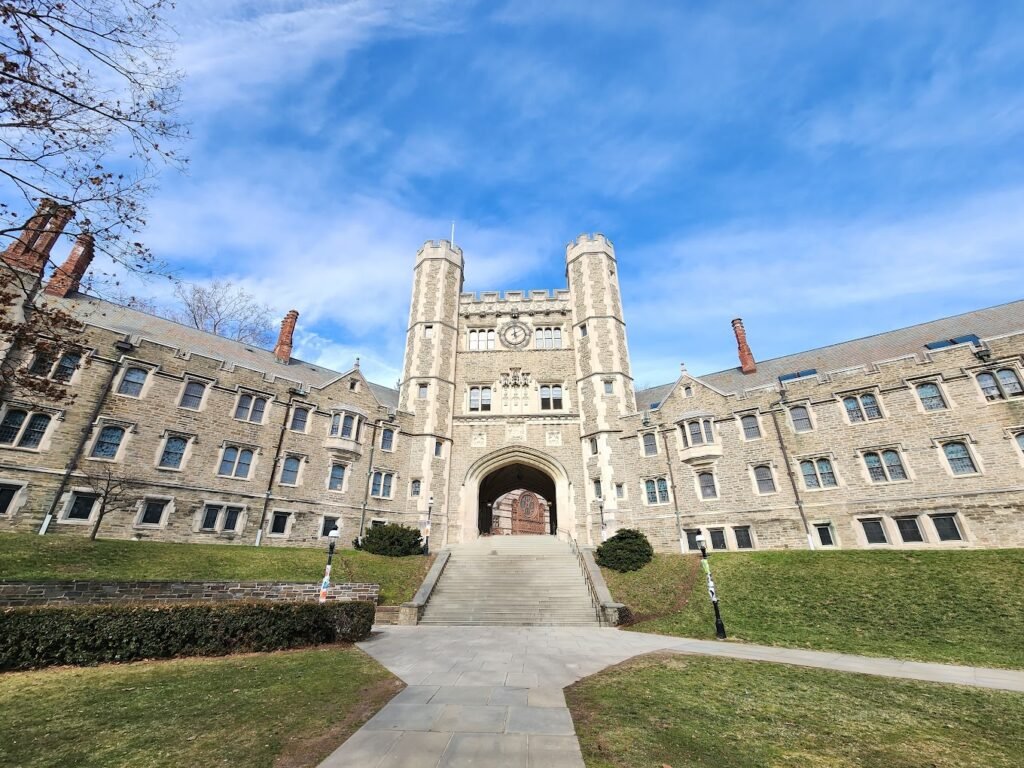
Princeton University is situated on a 600-acre campus in the town of Princeton, New Jersey, approximately equidistant between New York City and Philadelphia. The campus is widely regarded as one of the most beautiful in the United States, featuring Gothic-style architecture, landscaped gardens, and historic buildings.
Key landmarks include Nassau Hall, the oldest building on campus, Firestone Library, one of the largest university libraries in the world, and the Lewis Arts Complex, which supports creativity in the visual and performing arts. The campus environment provides a balance between academic focus and natural beauty, creating an ideal setting for learning and research.
Academic Philosophy and Excellence
Princeton University is particularly known for its strong emphasis on undergraduate education. Unlike many research universities, Princeton limits its graduate programs to doctoral degrees and does not offer professional schools such as law or business. This focus allows the university to dedicate exceptional resources and attention to undergraduate teaching.
Small class sizes, close interaction with faculty, and a curriculum that emphasizes critical thinking and independent research define the Princeton academic experience. The university’s commitment to academic excellence is reflected in its consistently high rankings among global universities.
Faculties and Academic Programs
Princeton is organized into four main academic divisions:
- Humanities
- Social Sciences
- Natural Sciences
- Engineering and Applied Science
The university offers a wide range of undergraduate and graduate programs across disciplines such as literature, history, economics, public policy, physics, mathematics, computer science, and engineering. Princeton’s curriculum encourages interdisciplinary study, allowing students to explore connections between fields and develop a broad intellectual foundation.
One of Princeton’s most distinctive academic features is the Senior Thesis. All undergraduate students are required to complete an original research project in their final year, demonstrating their ability to conduct independent scholarly work.
Research and Innovation
Research is a core component of Princeton University’s mission. The university supports a wide array of research initiatives that address some of the world’s most pressing challenges, including climate change, artificial intelligence, public policy, energy sustainability, and global health.
Princeton researchers have made groundbreaking contributions to fields such as theoretical physics, economics, neuroscience, and political science. The university is also home to renowned research centers and institutes, including the Princeton Plasma Physics Laboratory, which conducts advanced research on fusion energy, and the Institute for Advanced Study, which has hosted some of the world’s greatest thinkers.
Faculty and Nobel Laureates
Princeton University boasts an exceptional faculty that includes numerous Nobel Prize winners, Pulitzer Prize recipients, and members of prestigious academic academies. Faculty members are leaders in their respective fields and are deeply engaged in both teaching and research.
Notable scholars associated with Princeton include Albert Einstein, who was affiliated with the Institute for Advanced Study, and John Nash, the Nobel Prize-winning mathematician whose life was portrayed in the film A Beautiful Mind. These individuals exemplify Princeton’s long tradition of intellectual excellence and innovation.
Student Life and Campus Culture
Princeton offers a vibrant and intellectually stimulating campus life. The university has a relatively small student population, which fosters a close-knit community and encourages collaboration among students. Undergraduate students often live on campus throughout their studies, contributing to a strong sense of belonging.
The university’s unique residential college system integrates academic advising, social activities, and housing. Students can participate in hundreds of student organizations, including cultural clubs, academic societies, performing arts groups, and athletic teams.
Princeton also has a distinctive social tradition known as eating clubs, which serve as social and dining organizations for upper-class students.
Diversity and Inclusion
Princeton University is committed to promoting diversity, equity, and inclusion across its campus community. The university actively recruits students from diverse socioeconomic, cultural, and geographic backgrounds, including a significant number of international students.
Through scholarships, financial aid programs, and support services, Princeton ensures that talented students can access education regardless of their financial circumstances. The university’s need-based financial aid policy allows many students to graduate debt-free.
Athletics and Extracurricular Activities
Princeton University has a strong athletic tradition and is a member of the Ivy League. The university offers a wide range of varsity, club, and intramural sports. Princeton’s athletic teams, known as the Tigers, have achieved success in sports such as rowing, basketball, soccer, and track and field.
In addition to athletics, students are encouraged to engage in extracurricular activities that support leadership development, teamwork, and community service.
Global Influence and Alumni Network
Princeton University’s influence extends far beyond its campus. Its alumni network includes leaders in government, business, academia, science, and the arts. Notable alumni include U.S. Presidents, Supreme Court justices, Nobel laureates, and CEOs of major global organizations.
The university maintains strong global partnerships and encourages international collaboration through research initiatives, exchange programs, and global studies opportunities.
Challenges and Academic Pressure
While Princeton is known for its supportive academic environment, the high standards and rigorous coursework can be demanding. Students are encouraged to balance academic excellence with personal well-being, and the university provides mental health resources, advising, and wellness programs to support students throughout their studies.
Conclusion
Princeton University stands as a symbol of academic excellence, intellectual freedom, and leadership development. With its historic legacy, commitment to undergraduate education, world-class research, and global impact, Princeton continues to shape the future of education and scholarship.
For students seeking a rigorous academic environment, close mentorship from leading scholars, and opportunities to make meaningful contributions to society, Princeton University offers an unparalleled educational experience.
If you would like this article optimized for SEO, shortened, rewritten for a blog, or converted into a PDF, feel free to ask.